The Syrian conflict, which began in March 2011, has seen some of the worst human rights atrocities and human suffering ever and remains one of the most catastrophic humanitarian crises of modern times. This initiative endeavours to advance the cause of human rights, accountability and solidarity, with a specific emphasis on the Syrian conflict.
Full narrative
If you want to know more about Art for justice & accountability, please have a look at our detailed narrative.
Lab Project
The Lab category features emerging project concepts exploring future artistic possibilities. These sketches represent coculture's exploratory spirit, highlighting innovative ideas awaiting development.
While realization isn't guaranteed, this space invites viewers to envision the potential of transformative art and cultural narratives.
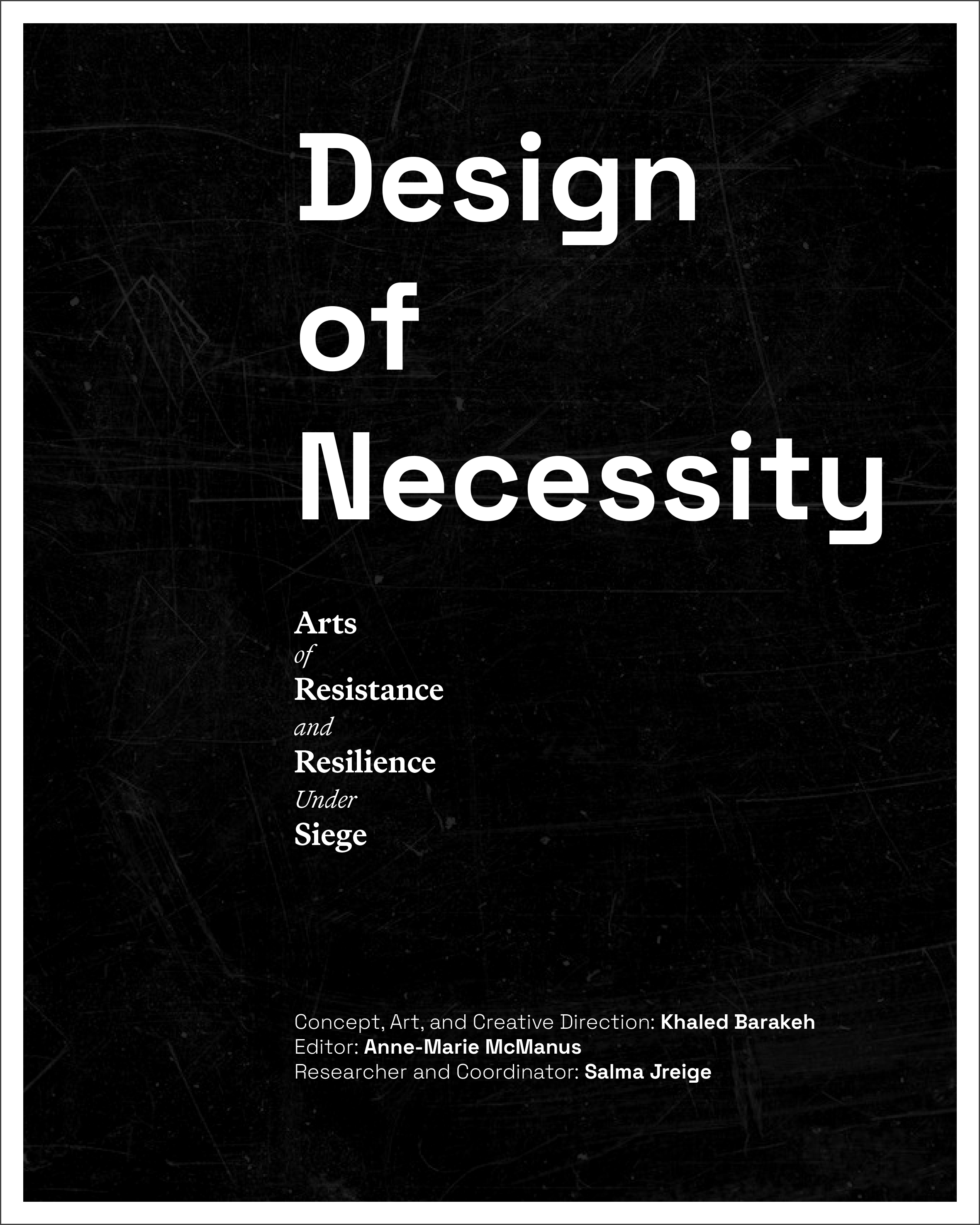
Design of Necessity Book
Between 2011 and 2018, an estimated two and a half million Syrians were impacted by siege. What will be the legacies of siege memory – of survival, resilience, and loss – and how will these memories shape justice in post-Assad Syria? The book Design of Necessity, which grew from Khaled Barakeh’s 2022 exhibition of the same name, uniquely spans the fields of conceptual art, academia, literature, and legal activism to document and reflect on the impact of Syria’s sieges. With contributions from over twenty authors – including creative writers, siege survivors, photographers, activists, academics, and legal experts – this book shows how siege was integral to Syria's war, functioning as a method in the Assad regime's annihilation policies alongside imprisonment, forced disappearance, forced displacement, and other violations. The book’s incorporation of multiple lenses on the sieges in Syria opens plural perspectives on memory and justice for this cruel form of warfare, while simultaneously raising a call for urgent action against the growing normalization of urban sieges worldwide since the 2010s.
Solidarity and connection lie at the heart of Design of Necessity, both the book and its original exhibition. As Design of Necessity documents, Barakeh's relational art practice for the exhibition was inspired by Syrian communities’ repurposing of ordinary objects to survive the sieges, including solar ovens and mushroom cultivation. Written primarily before the fall of the Assad regime, the book honors Syrians’ resilience while critically pointing to the state violence and international paralysis that imposed the necessity for resilience on them. Since the regime's fall in December 2024, the book reflects, the meanings of archiving Syria’s sieges across multiple registers and sites of experience have also transformed. As Syria embarks on a long road of transitional justice, Design of Necessity imagines and enacts the archiving of siege as a relational, living practice for accountability in the present.
Concept, Art, and Creative Direction: Khaled Barakeh
Editor: Anne-Marie McManus
Researcher and Coordinator: Salma Jreige
Reincarnation
The Transformation and Transfiguration of Public Places Through Graffiti
Reincarnation is a multi-city project that reincarnates some of the most iconic Syrian graffiti pieces to new European locations and commissions new graffiti pieces in Syria and Ukraine. The title metaphorically resonates with the spiritual belief of rebirth seen in the Druze faith, a monotheistic, Abrahamic religion centred in the Middle East that believes the soul is reborn in a new body after death.
The Syrian graffiti started as a movement when 13-year-old boys sprayed anti-regime slogans on their school walls in Daraa, sparking the uprising. Since then, graffiti has become a visual tool in the psychological war against the regime, evolving into more pictorial works and encompassing universal messages.
The project brings Syrian and Ukrainian graffiti artists together with their European counterparts, replicating iconic pieces in various cities to highlight the ongoing intersectional struggles and resistance. It delves into transforming public spaces, employing reincarnation as a metaphor for the perpetual rebirth of resistance and resilience.
The first Reincarnation activity took place last year at the Graffiti Hangar Ystadgatan/Enskifteshagen, featuring the work of Abu Malik Al-Shami. Amid the Syrian Revolution's turmoil, Al-Shami adorned conflict-ridden walls with over a hundred poignant graffiti pieces. The project extended to two additional locations, P-huset Anna, the oldest legal graffiti wall in Sweden, and Folketspark, hosting an on-site reenactment of the graffiti of 13-year-old boys. Bearing the message "It's your turn, Doctor," directed at President Bashar al-Assad, this graffiti mirrors the spirit of the Arab Spring, marking the onset of civil unrest and the Syrian revolution.

MUTE in Brussels
As part of the campaign, the installation MUTE by conceptual artist and activist Khaled Barakeh was displayed in Brussels, Place Jean Rey on 30 April 2024. The presentation was part of the Cultural Agenda of the Brussels VIII Conference, "Supporting the Future of Syria and the Region," which the European Union organises annually.
The public art installation pays tribute to those who fought for freedom in Syria, especially victims and survivors, and calls for justice and accountability for the violations committed over the past years. MUTE depicts 49 figures of protesters dressed in clothes belonging to Syrian activists and tells the story of "an abandoned people" left to fend for themselves in their fight for freedom and justice. Swinging between stillness and motion, these protesters are frozen in postures that evoke demonstrations' physical tension and emotional intensity. The heads were removed and reconstructed to look inside the bodies, bringing back memories, traumas, and anguish. The faces turned into horn-like openings, evoking the protests against the injustices and amplifying the voices once silenced.
The art for justice and accountability campaign aims to elevate the voices and demands of Syrian victims, survivors, and their families on the international agenda. In particular, it insists on prioritising the issue of Syria's more than 100,000 missing. Habib Nassar, Director of Policy and Research at Impunity Watch, says: "Despite the absence of a political transition in Syria, Syrian victims and their families have continued to fight for justice and truth. Initiatives like MUTE, seek to highlight their plight and unwavering activism to seek answers."
In parallel, a group of survivor and family associations under the Truth and Justice Charter organized a side event on the ongoing efforts to address the crisis of missing persons in Syria, namely the creation of the Independent Institution on Missing Persons in the Syrian Arab Republic (IIMP) and the role that victims and survivors can play in it.


Current and Upcoming Events

Related Activities


